
What is Britain?

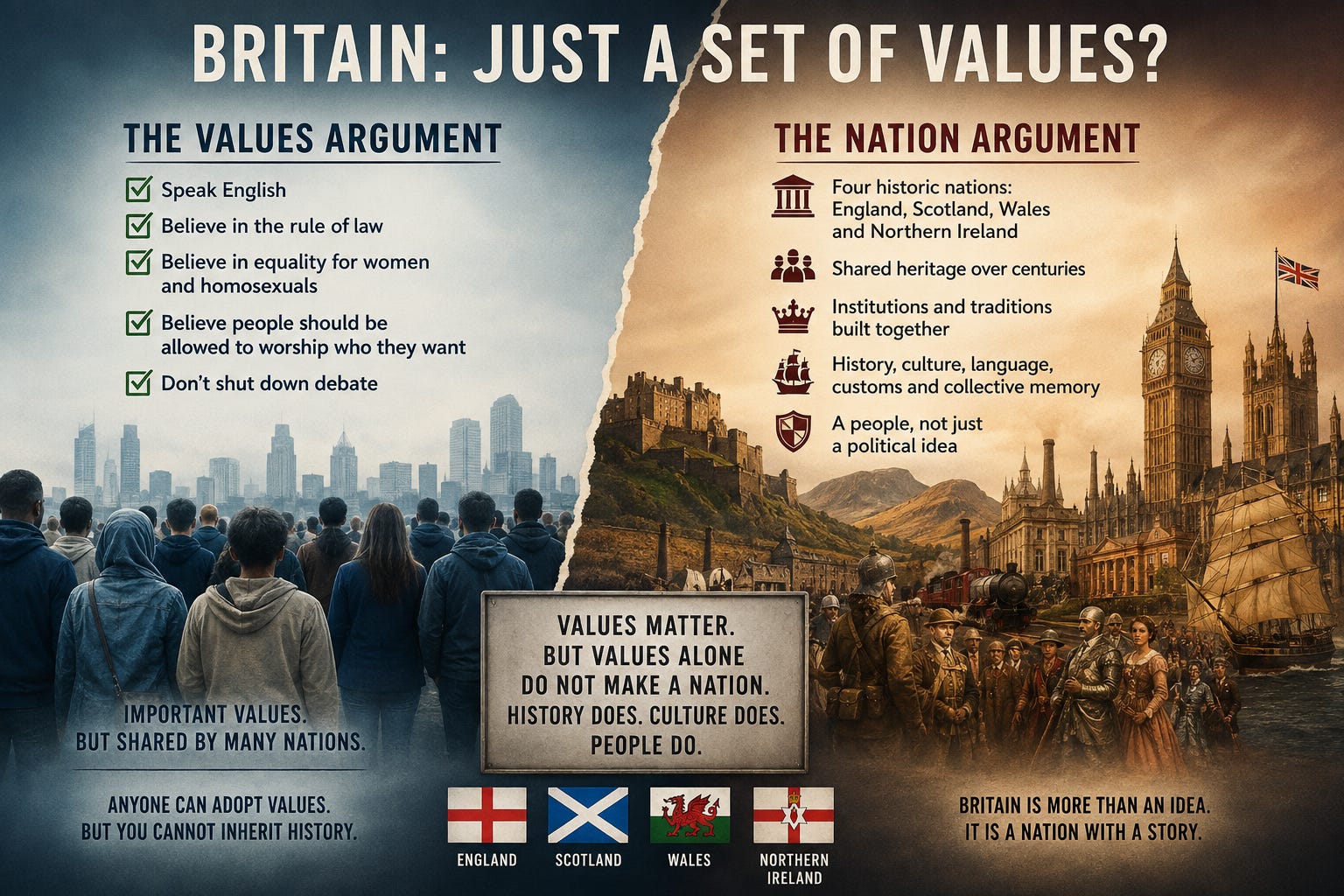
I happened to catch an interview between TalkTV’s Julia Hartley-Brewer and Restore Britain’s Charlie Downes the other day whilst out driving in the car. Since then, this clip has gone viral. It wasn’t really just another social media spat. It raised what I think is one of the biggest questions facing Britain today.
What actually makes someone British?
Here’s the clip so you can judge it for yourself.
It got me thinking and I wanted to go a bit deeper into this topic as it is so fundamentally important to all of us
According to Julia;
Speak English. Believe in the rule of law. Believe in equality. Support freedom of worship. Don’t silence debate. Gay Rights. Enjoy queuing
Now whilst I think many will find those values reasonable enough, is that really IT when it comes to being British? Is there anything unique about them?
You see millions of Americans, Australians, Canadians all believe exactly these same things. If these values are the foundational values that define Britishness, what actually makes Britain any different from any other liberal democracy? Are Americans also British? When you start to think about it, values alone don’t cut it.
I think this is the core issue here and it is worth a deep dive.
Britain Existed Before Liberalism
The historical truth is that Britain existed for centuries before many of today’s liberal principles became widely accepted. There was a time when women did not enjoy equal political rights. Homosexuality was criminalised. Religious freedom was often restricted, and people were even killed because of their beliefs.
Yet nobody seriously argues that eighteenth-century Britain or Victorian Britain somehow wasn’t British!
Winston Churchill’s generation did not hold many of today’s liberal views. Are we really saying Churchill wasn’t British?
Queen Elizabeth I almost certainly wouldn’t have passed Julia’s modern values test either, yet few people better embodied Britannia than she did.
Look, of course values are important but value change to reflect social norms. Our country exists because a people, history and culture existed. I think that’s the point that Downes was trying to make (a bit clumsily in my view) and it seemed to annoy Julia.
I also think I know why that annoyed her and I will get to that a bit later.
Britain is W.I.S.E.
I would contend that Britain is made up of many things. It is a shared history going back millennia. We share inherited traditions that date back a very long time. Yes we do share a language, English, but there is also Gaelic, Irish and Welsh. There are families living in these islands whose ancestry goes back a thousand years or more! My own ancestry here where I live in Northern Ireland goes back to the 1690’s and I can prove it! (Before that my family lived in the Scottish lowlands) This all gives is a collective memory and sense of our roots.
Britain is W.I.S.E. (Welsh, Irish, Scottish and English)
Values matter.
But they are only one part of the national identity. They are NOT solely national identity and they alone do not define it.
The Replacement Question
Here is the tough question we all have to consider,
Let’s try a thought experiment here.
Just Imagine if you will that over the next hundred years every indigenous British person disappeared. England, Scotland, Wales and Northern Ireland remained exactly where they are. Buckingham Palace still stood. Parliament still met at Westminster. The Union Flag still flew. But the population had been entirely replaced by people whose families originated in Pakistan, Somalia or elsewhere else
Then follow that thought up by imagining that every one of those new citizens spoke fluent English. They respected the rule of law. They believed in democracy. They supported equality between men and women. They defended free speech. They believed people should be free to practise whichever religion they chose.
In other words, they ticked every box on Julia Hartley-Brewer’s list.
The question is a simple one.
Would Britain still be Britain?
It’s a tough one for the Values only people!
I don’t mean just geographically. I don’t mean legally or even constitutionally!
Would Britain still be the same nation?
See the problem?
If your answer is “yes”, then Britain’s people become irrelevant. The British nation survives even if the British people disappear because all that matters is subscribing to a set of liberal principles.
If your answer is “no”, then you’ve already accepted that nationhood is about more than values.
It DOES involves continuity. It DOES involve ancestry, shared memories, inherited customs, collective experience and a solid culture passed from one generation to the next.
That doesn’t mean that nobody can ever become British. Of course they can. Britain has always absorbed newcomers who have made enormous contributions to our national life.
But successful integration has traditionally meant relatively small numbers joining an existing nation, not replacing it.
I think this is what Charlie Downes was saying and that is what triggers Julia. There is a massive difference between immigration that adds to Nation and a demographic change that ultimately changes the Nation,
I believe that Nations are not interchangeable populations living within fixed borders. They are living communities, shaped over many centuries by the people who built them.
And that is why this debate matters so much.
At first glance this looks like an argument about immigration.
I disagree. It is about how we define our nation
Making it about race misses this point although I do get it.
It is about whether Britain is simply a political project—a collection of liberal ideas that anyone can adopt—or whether it is a historic nation, rooted in the four home nations of England, Scotland, Wales and Northern Ireland, bound together by a shared inheritance stretching back centuries.
Julia Hartley-Brewer’s list describes the sort of society she wants Britain to be.
That is Fair enough but it really doesn’t explain what Britain actually is.
It is not simply a legal framework or a collection of fashionable liberal values.
It is four historic nations, England, Scotland, Wales and Northern Ireland.
It is that shared history, that culture, those institutions, our traditions and the generations before us who built them.
Yes, values matter.But values alone do not make a nation.
History does. Culture does.
If Britain is nothing more than just a shopping list of values, then demographics become irrelevant.
If Britain is a historic nation with a distinct identity formed over generations, then the people who carry that identity absolutely matter.
That, ultimately, is the question Julia Hartley-Brewer’s definition never really answers
I believe Julia is a well intentioned classic liberal and I am not trying to be unfair to her. I understand many may share her values understanding of being British
The problem is that is we accept, we lose our Britishness!
If you’ve enjoyed reading this, I’d love for you to join my community.
I publish regular political analysis, overlooked history and the occasional book review that challenges the mainstream narrative.
Free subscribers receive every article.
Paid members also receive The Saturday Briefing, my exclusive weekly analysis launching this September.
If that sounds like your sort of thing, come aboard!
Many, many people struggle with the concept of what it means to be British, and this Substack nails it, so congratulations David on getting to grips with this thorny issue (and actually what you write here about Britain applies to every sovereign nation).
As an aside, we share a similar ancestry as my mother's ancestors - Grahams - also moved from Lowland Scotland to Ireland. My grandfather studied medicine at Trinity College Dublin, met my grandmother (nee Dunbar) working as nurse in Edinburgh), and he went on to work in the R.A.M.C.
Concise and clear exposition, David, thank you.